 arithmos
MAKE THE MATHEMATICS YOURSELF
Euler’s totient fan in C
A complete program. Standard C, a compiler, and the rule behind the shape.
FROM SOURCE TO SHAPE
Run it in three steps.
- Save the source.
Download totient-fan.c into a folder on your computer.
- Compile it.
In that folder, run this with GCC or Clang:
cc -std=c11 -O2 totient-fan.c -lm -o totient-fan - Make the image.
./totient-fanOpen
totient-fan.svgin a browser to see the result.
On Windows with GCC, name the executable totient-fan.exe and run it from the same folder.
THE RULE IN THE PROGRAM
How the picture is built
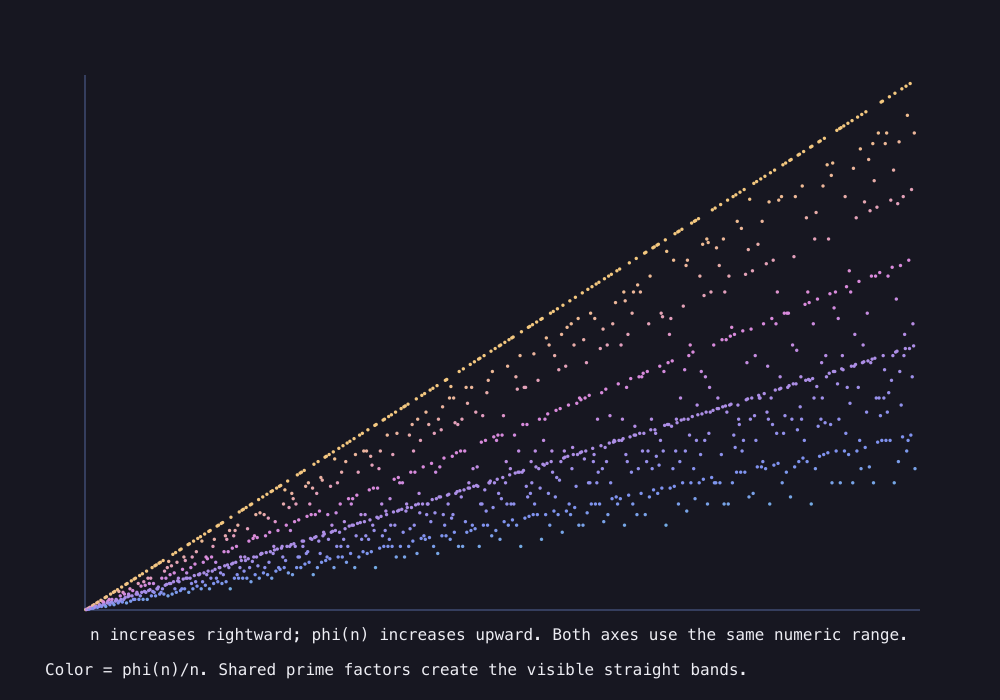
Use a totient sieve, then plot integer n against phi(n), coloring by phi(n)/n.
Make it your own
limit=1200
Both axes span 0 to limit but are stretched to fit the rectangular canvas. Finite point bands reflect factorization, not continuous curves. Each run produces one image; use Graphic mode for the interactive animation.
/* Arithmos: totient-fan
* Compile: cc -std=c11 -O2 totient-fan.c -lm -o totient-fan
* Run: ./totient-fan
* Output: totient-fan.svg (open this file in a browser)
* Optional output path: ./totient-fan my-image.svg
* Edit the constants in draw() to explore another case.
*/
#include <math.h>
#include <stdint.h>
#include <stdio.h>
#include <stdlib.h>
#include <string.h>
static FILE *nt_out;
#define NT_PI 3.14159265358979323846
/* The small SVG writer keeps this program free of graphics dependencies.
* Coordinates are pixels on a 1000 x 700 drawing surface.
* t runs from 0 to 1 through mint, blue, rose, and gold.
*/
static inline void nt_color(double t, char hex[8]) {
const double stops[4][3] = {
{91,227,201}, {128,146,240}, {218,138,220}, {244,200,127}
};
t = fmax(0.0, fmin(1.0,t)) * 3.0;
int band = (int)fmin(2.0,floor(t));
double blend = t - band;
int r[3];
for (int k=0;k<3;k++) r[k]=(int)lround(stops[band][k]*(1.0-blend)+stops[band+1][k]*blend);
snprintf(hex,8,"#%02x%02x%02x",r[0],r[1],r[2]);
}
static inline void nt_line(double x,double y,double X,double Y,double t,double alpha,double width) {
char color[8];nt_color(t,color);
fprintf(nt_out,"<path d=\"M%.3f %.3f L%.3f %.3f\" fill=\"none\" stroke=\"%s\" stroke-opacity=\"%.3f\" stroke-width=\"%.3f\"/>\n",x,y,X,Y,color,alpha,width);
}
static inline void nt_dot(double x,double y,double r,double t,double alpha) {
char color[8];nt_color(t,color);
fprintf(nt_out,"<circle cx=\"%.3f\" cy=\"%.3f\" r=\"%.3f\" fill=\"%s\" fill-opacity=\"%.3f\"/>\n",x,y,r,color,alpha);
}
static inline void nt_circle(double x,double y,double r,double t,double alpha,double width) {
char color[8];nt_color(t,color);
fprintf(nt_out,"<circle cx=\"%.3f\" cy=\"%.3f\" r=\"%.3f\" fill=\"none\" stroke=\"%s\" stroke-opacity=\"%.3f\" stroke-width=\"%.3f\"/>\n",x,y,r,color,alpha,width);
}
static inline void nt_rect(double x,double y,double w,double h,double t,double alpha) {
char color[8];nt_color(t,color);
fprintf(nt_out,"<rect x=\"%.3f\" y=\"%.3f\" width=\"%.3f\" height=\"%.3f\" fill=\"%s\" fill-opacity=\"%.3f\"/>\n",x,y,w,h,color,alpha);
}
static inline void nt_text(double x,double y,const char *text) {
fprintf(nt_out,"<text x=\"%.3f\" y=\"%.3f\" fill=\"#ededf3\" font-family=\"monospace\" font-size=\"16\">",x,y);
for (;*text;text++) {
if (*text=='&') fputs("&",nt_out);
else if (*text=='<') fputs("<",nt_out);
else if (*text=='>') fputs(">",nt_out);
else fputc(*text,nt_out);
}
fputs("</text>\n",nt_out);
}
static inline int nt_gcd(int a,int b) {a=abs(a);b=abs(b);while(b){int r=a%b;a=b;b=r;}return a;}
static inline int nt_prime(int n) {if(n<2)return 0;for(int d=2;d<=n/d;d++)if(n%d==0)return 0;return 1;}
/* Euler's totient counts 1 <= k <= n with gcd(k,n)=1. */
static void draw(void) {
const int limit=1200; /* Editable largest integer. */
int *phi=malloc((size_t)(limit+1)*sizeof *phi);if(!phi)return;
for(int n=0;n<=limit;++n)phi[n]=n;
for(int p=2;p<=limit;++p)if(phi[p]==p)
for(int k=p;k<=limit;k+=p)phi[k]-=phi[k]/p;
nt_line(85,610,920,610,.3,.6,1);nt_line(85,610,85,75,.3,.6,1);
for(int n=1;n<=limit;++n)
nt_dot(85+830.0*n/limit,610-530.0*phi[n]/limit,1.7,(double)phi[n]/n,1);
nt_text(90,640,"n increases rightward; phi(n) increases upward. Both axes use the same numeric range.");
nt_text(45,675,"Color = phi(n)/n. Shared prime factors create the visible straight bands.");
free(phi);
}
int main(int argc, char **argv) {
if (argc > 2) {
fprintf(stderr, "Usage: %s [OUTPUT.svg]\n", argv[0]);
return EXIT_FAILURE;
}
const char *filename = argc == 2 ? argv[1] : "totient-fan.svg";
nt_out = fopen(filename, "wb");
if (!nt_out) { perror(filename); return EXIT_FAILURE; }
fputs("<svg xmlns=\"http://www.w3.org/2000/svg\" width=\"1000\" height=\"700\" viewBox=\"0 0 1000 700\">\n"
"<rect width=\"1000\" height=\"700\" fill=\"#171721\"/>\n", nt_out);
draw();
fputs("</svg>\n", nt_out);
int failed = ferror(nt_out);
if (fclose(nt_out) != 0) failed = 1;
if (failed) { fputs("Could not finish writing the image.\n", stderr); return EXIT_FAILURE; }
printf("Wrote %s\n", filename);
return EXIT_SUCCESS;
}
All 40 explorations, ready to compile.Download all C examples ↓