 arithmos
Julia: one rule, infinite starting points in C
A complete program. Standard C, a compiler, and the rule behind the shape.
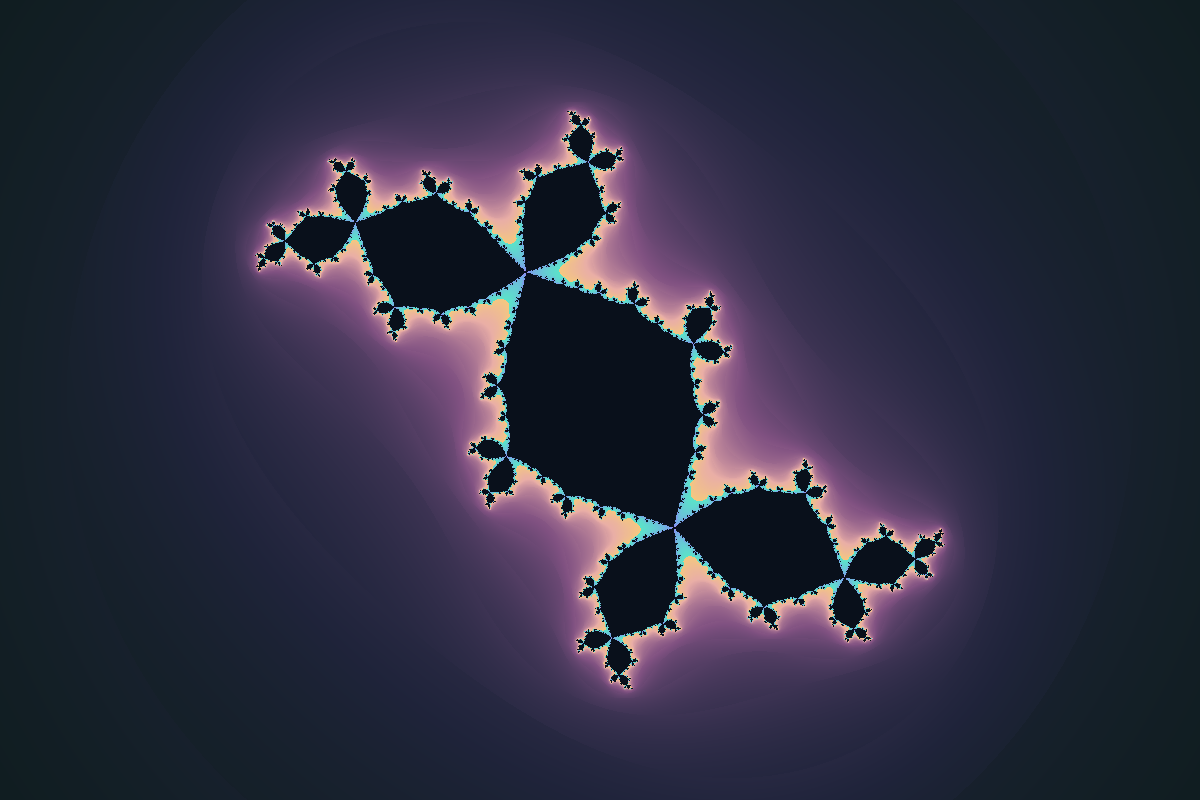
Run it in three steps.
- Save the source.
Download julia.c into a folder on your computer.
- Compile it.
In that folder, run this with GCC or Clang:
cc -std=c11 -O2 julia.c -lm -o julia - Make the image.
./juliaThe program writes
julia.ppm, a portable image file. Open it with a PPM-capable image viewer or convert it to PNG.
On Windows with GCC, name the executable julia.exe and run it from the same folder.
How the picture is built
Here the quadratic rule stays fixed while each pixel supplies a different starting point. Squaring has two inverse branches, so repeated pullbacks create paired lobes, filaments, or separated dust. The critical orbit of zero determines whether the filled Julia set is connected; the Mandelbrot set collects exactly the parameters for which it is. Comparing the rabbit, basilica, dendrite, and circle reveals genuinely different orbit structures behind their silhouettes, rather than different color treatments of one shape.
Make it your own
Pass width, height, and an iteration limit when running the program.
./julia 1600 1000 300 large.ppmThe non-escaping region approximates the filled Julia set; its boundary is the Julia set. A finite iteration cap does not prove boundedness. The rabbit parameter is a numerical approximation; only the exact algebraic center has exactly periodic critical orbit. Color is an escape-time convention. Each run produces one image; use Graphic mode for the interactive animation.
/* Arithmos: draw the filled Julia set using only standard C and libm.
 *
 * Compile: cc -std=c11 -O2 julia.c -lm -o julia
 * Run:     ./julia
 * Options: ./julia WIDTH HEIGHT ITERATIONS OUTPUT.ppm
 * Example: ./julia 1600 1000 300 julia.ppm
 *
 * The output is a binary PPM (P6) image. It needs no graphics library.
 * Dark pixels have not escaped within the iteration limit; that alone
 * does not prove they belong to the filled Julia set.
 * The constant below gives the Douady rabbit; each pixel starts its own orbit.
 */
#include <errno.h>
#include <math.h>
#include <stdio.h>
#include <stdlib.h>

/* Read a positive integer, rejecting malformed or excessive values. */
static int read_int(const char *text, int minimum, int maximum) {
    char *end;
    errno = 0;
    long value = strtol(text, &end, 10);
    if (errno || end == text || *end || value < minimum || value > maximum) {
        fprintf(stderr, "Expected an integer from %d to %d: %s\n",
                minimum, maximum, text);
        exit(EXIT_FAILURE);
    }
    return (int)value;
}

/* Interpolate through the website's mint, blue, rose and gold palette. */
static void gradient(double smooth, unsigned char rgb[3]) {
    const double stops[4][3] = {
        {91, 227, 201}, {128, 146, 240},
        {218, 138, 220}, {244, 200, 127}
    };
    double t = fmod(log1p(fmax(0.0, smooth)) * 0.35, 1.0) * 3.0;
    int band = (int)t;
    double blend = t - band;
    double brightness = fmin(1.0, 0.11 + smooth / 12.0);
    for (int channel = 0; channel < 3; ++channel) {
        double color = stops[band][channel] * (1.0 - blend)
                     + stops[band + 1][channel] * blend;
        rgb[channel] = (unsigned char)lround(color * brightness);
    }
}

int main(int argc, char **argv) {
    if (argc != 1 && argc != 5) {
        fprintf(stderr, "Usage: %s [WIDTH HEIGHT ITERATIONS OUTPUT.ppm]\n", argv[0]);
        return EXIT_FAILURE;
    }
    int width = argc == 5 ? read_int(argv[1], 2, 4096) : 1200;
    int height = argc == 5 ? read_int(argv[2], 2, 4096) : 800;
    int limit = argc == 5 ? read_int(argv[3], 1, 2000) : 250;
    const char *filename = argc == 5 ? argv[4] : "julia.ppm";
    FILE *image = fopen(filename, "wb");
    if (!image) { perror(filename); return EXIT_FAILURE; }
    if (fprintf(image, "P6\n%d %d\n255\n", width, height) < 0) {
        fclose(image); return EXIT_FAILURE;
    }

    /* Choose a view of the complex plane; keep both axes at one scale. */
    const double center_real = 0.0, center_imag = 0.0;
    const double parameter_real = -0.1225611668766536;
    const double parameter_imag = 0.7448617666197442;
    double span_x = fmax(3.4, 3.0 * width / height);
    double span_y = span_x * height / width;

    for (int py = 0; py < height; ++py) {
        for (int px = 0; px < width; ++px) {
            /* Fix c; each pixel supplies a different starting value of z. */
            double zr = center_real + ((px + 0.5) / width - 0.5) * span_x;
            double zi = center_imag + (0.5 - (py + 0.5) / height) * span_y;
            double cr = parameter_real, ci = parameter_imag;
            int step = 0;

            /* z <- z*z + c, written in real and imaginary parts.
             * (a + bi)^2 = (a*a - b*b) + (2*a*b)i
             * Preserve the old real part until both updates are ready.
             */
            while (step < limit && zr * zr + zi * zi <= 4.0) {
                double next_real = zr * zr - zi * zi + cr;
                zi = 2.0 * zr * zi + ci;
                zr = next_real;
                ++step;
            }

            unsigned char rgb[3] = {9, 16, 27};
            if (zr * zr + zi * zi > 4.0) {
                /* Smooth the escape count to avoid hard color bands. */
                double magnitude = sqrt(zr * zr + zi * zi);
                double smooth = fmax(0.0, step + 1.0 - log2(log2(magnitude)));
                gradient(smooth, rgb);
            }
            if (fwrite(rgb, 1, 3, image) != 3) {
                perror("Writing image"); fclose(image); return EXIT_FAILURE;
            }
        }
    }
    if (fclose(image) != 0) { perror("Closing image"); return EXIT_FAILURE; }
    printf("Wrote %s (%d x %d, %d iterations)\n", filename, width, height, limit);
    return EXIT_SUCCESS;
}